Friday, May 20, 2016

KASB Blog: Brownback spares K-12 but cuts occurring as costs increase

Brownback spares K-12 but cuts occurring as costs increase

Gov. Sam Brownback spared K-12 from budget cuts but school cuts are occurring because the state budget locks in a third year of essentially flat school spending amid rising costs and expectations.

And Brownback said if the Kansas Supreme Court orders more funding for an equity fix to the school finance system that could force him to make more cuts to higher education and health care for the poor, which he slashed along with other areas in the amount of $97 million.

The actions announced Wednesday came as Brownback signed into law the state budget and made cuts, most notably to Medicaid and universities, to shore up the budget’s bottom line.

KASB said it appreciated the Legislature and Brownback not cutting K-12 funding, but noted the budget basically puts in place a freeze on the level of funding for the third straight year under the block grant finance system and increased costs causing school districts across the state to cutback on important services and programs.

On Wednesday, the state’s largest school district, Wichita USD 259, approved $18 million in budget cuts, which included the elimination of more than 100 positions, closing an alternative high school, and ending bus transportation for thousands of students. And more cuts are on the way, officials said.

Wichita school board vice president Mike Rodee blamed Brownback and legislative leaders for the school cuts. “All of these budget cuts are tough. There’s nobody up here that likes it. But we need to look at the people that are doing it to us,” Rodee was quoted in Thursday’s Wichita Eagle. “Our legislators, our government, our governor — we are the ones who are fighting to keep the schools alive and they are fighting to close them,” he said.

But Brownback’s office said the budget shielded K-12 funding during tough economic times.

“Our economy continues to face challenges with declines in oil and gas production, agriculture and aviation, our three major industries. This budget recognizes those challenges while protecting K-12 education and public safety,” the office said.

When legislators approved the budget sent to Brownback they assumed
he would have to make some cuts so they also passed a proviso to protect K-12 from those cuts. Brownback could have vetoed that proviso but didn’t.

Wednesday, May 18, 2016

Set Up for More Financial Trouble

Set Up for More Financial Trouble
By Kansas Center for Economic Growth Senior Fellow Duane Goossen

Expect financial turmoil in Kansas to continue. Lawmakers left Topeka after approving revisions to the budgets already in place for FY 2016 and FY 2017, but failed to solve the underlying problem facing the state. As a result of unaffordable tax cuts, Kansas does not receive enough revenue to pay the bills.

Here's the high-level general fund profile for FY 2016 based on legislative action:


Now let's go one step further and break out the one-time transfers from total revenue:


The FY 2016 budget that lawmakers passed has a large structural imbalance, and would leave the general fund $140 million below zero at the end of the fiscal year. To avoid the negative ending balance, lawmakers are expecting the governor to use his powers to transfer yet another $70 million from the highway fund. That would technically increase general fund revenue, but it's more one-time money that does not narrow the structural imbalance. Lawmakers also expect the governor to "delay" a $96 million payment to the retirement system until FY 2018, which would lower total expenditures in FY 2016 but increase expenditures in FY 2018.
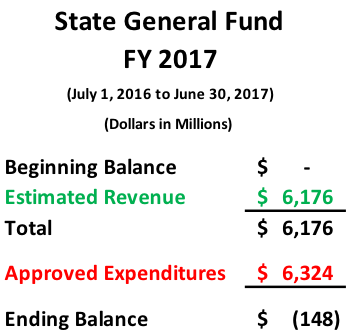
Now, look at FY 2017 based on the recent legislative budget action:


Again, let's go one step further and break out the revenue projection to show one-time transfers: 


The FY 2017 budget also has a large structural imbalance and a negative ending balance. Lawmakers are expecting the governor to order an additional transfer of $115 million from the highway fund, and to also cut expenditures (details of the cuts unknown) enough to avoid the negative ending balance.
Now consider FY 2018. When lawmakers convene a new legislative session in January, they must create a brand-new budget for FY 2018. How will that work?
Recurring revenue in FY 2017 totals $5.9 billion. With luck, that might grow a little in FY 2018, but under current policy, hoping for much more than $6.0 billion would be quite optimistic. Legislators set expenses for FY 2017 at $6.324 billion, but in FY 2018 expenses will be higher. The 4th quarter KPERS payment from FY 2016 must be paid. Add $96 million plus 8 percent interest for that. Medicaid costs will go up $60 or $70 million, maybe more. Of course other costs will rise as well, but just the Medicaid and KPERS increases alone will push expenses to $6.5 billion, far above recurring revenue. And the bank account will be empty and the highway fund tapped out.
Will lawmakers be able to address problems in the budget like staffing shortages at state hospitals and prisons? Not without making the overall financial situation worse.

What happens if the Kansas Supreme Court declares school funding constitutionally inadequate? The state will have little recourse.
What happens if the economy actually goes into recession? Everything gets worse.
The Kansas budget has been structurally unbalanced every year since the 2012/2013 tax cuts went into effect, putting the state in a highly precarious financial situation. Budget actions in this legislative session did not address or correct that.

The state's grim financial prognosis will persist until the underlying problem gets fixed. 
  

Monday, May 9, 2016

KS Association of School Board's Guide to Kansas Supreme Court Proceeding in School Finance Lawsuit Case

Guide to Kansas Supreme Court proceeding in school finance lawsuit case

At 9 a.m. Tuesday, the Kansas Supreme Court will hear oral arguments in the school finance lawsuit.
THE DISPUTE:
In this long-running litigation, the Kansas Supreme Court in February said the school finance law was unconstitutional because it created inequities in funding and tax burden that harmed low wealth districts and their students.
In March, the Legislature approved a bill supporters say cures those inequities, while the school districts suing the state say the amount of funding falls short and the law allows continued unequal tax treatment.
On Tuesday, both sides will present their cases to the court, and if past hearings on school finance are any indication, there will be many questions from the justices.
WHY IT’S IMPORTANT:
The court has ruled the Kansas Constitution requires that school districts must have reasonably equal access to substantially similar educational opportunity through similar tax effort. In its February decision, the court said without a constitutionally equitable finance system, schools would be unable to operate after June 30. Both the state and plaintiff districts say a shutdown of schools would be harmful but some districts have started planning for a “worst-case scenario,” if the court and Legislature fail to agree on a remedy.
MONEY MATTERS:
The new law doesn’t provide any new funding for schools, but shuffles what was appropriated earlier. Most are in agreement the state’s continued revenue shortfalls will require Gov. Sam Brownback to make significant budget cuts, which raises concerns about where the state would get the money if the court ruled an increase was necessary.
TIMING IS EVERYTHING:
Tuesday’s oral arguments are seven weeks before the June 30 school shutdown deadline. Schools have numerous programs in place during the summer and are gearing up for the next school year. Any disruption of funding could threaten summer programs, employee pay, maintenance of facilities and the timely start of the next school year.
WHAT HAPPENS NEXT:
After the oral arguments, the court takes the case under advisement and then issue a decision. Although the court is under no specific deadline, the court has put the case on a fast-track, and most believe it will announce a decision soon. A ruling against the state could prompt a special Legislative Session or legislators could return for the official close of the 2016 session on June 1 and deliberate then. Separate from the equity case, an even bigger portion of the school finance lawsuit remains before the Kansas Supreme Court and that revolves around whether the level of school funding is adequate for students to meet educational outcomes set by the state.  A three-judge panel has ruled state funding falls far short; a decision that, if upheld, could mean $550 million more per year for schools. A ruling in that case is not expected until probably next year.

Tuesday, April 26, 2016

Kansas Center for Economic Growth "Option Four" Plan

KCEG to host joint press conference, present "Option Four" plan
From Annie McKay, Kansas Center for Economic Growth Executive Director

As an advocate for responsible budget and tax policy and the work of the Kansas Center for Economic Growth, you understand the impact today's investments have in shaping our state's future.

As you've probably read in the news, Kansas once again faces another significant budget crisis. Governor Sam Brownback has proposed three options for filling the $300 million dollar budget gap for this fiscal year and next, none of which are fiscally responsible.Obviously, KCEG strongly opposes further cuts or sweeps to investments in Kansas' future prosperity and we also strongly oppose any additional temporary, one-time budget band aids that damage Kansas' economic prosperity and the well-being of our communities.

While the Governor has said that it isn't useful to discuss the very problem that set Kansas on this path, we disagree. With that in mind, we are gathering at the Statehouse on Wednesday, April 27 to advocate for "Option 4" as the Kansas Legislature reconvenes for the annual Wrap Up Session. Leaders from participating organizations, including myself and our senior fellow, Duane Goossen, will speak in the Visitor Center Auditorium from 9:00 - 9:30 a.m. The auditorium is located near the north entrance of the Capitol Building on the ground level. This is an event for both media and the general public, and we hope you'll be able to join us.

We cannot continue to struggle to get by year after year, knowing that Governor Brownback's failed economic experiment will not bring widely shared prosperity to the state. Kansans shouldn't have to choose between supporting early education programs, Kansas' K-12 system, higher education, roads, or public retirees. We must invest strongly in all of these things if we are going to move Kansas forward. The only proposal lawmakers should be willing to accept is one that will restore our state's financial stability and allow us to once again invest in our future. We cannot afford to sacrifice state investments any longer.

I hope you will join us on Wednesday morning, as we take a stand to fix the problem.

You can RSVP here.

Thank you for your ongoing support of KCEG and restoring responsible budget and tax policy in the Sunflower State.

Annie McKay  

Wrap-up session starts Wednesday with many school issues still up in the air: A blog by KASB

Wrap-up session starts Wednesday with many school issues still up in the air

The Kansas Legislature returns Wednesday for the so-called wrap-up session to find a lot left unwrapped, including many measures that would affect public schools.
Since the end of the first part of the 2016 session last month, state tax receipts cratered again; this time producing a $94 million revenue hole in the current fiscal year and $135 million in the next one, which starts July 1.
In response, Gov. Sam Brownback has provided legislators with several proposed budget cuts, including a $57 million cut to public schools, which his budget director, Shawn Sullivan, has described as the governor’s least favorite option.
Some legislators have called for a reversal of Brownback’s tax exemption for business owners, but Brownback has signaled he is not interested in tackling that subject.
In addition to the funding problem, there are numerous other education issues yet to be decided.
House Bill 2741 would institute sweeping changes to public schools that are opposed by KASB and other education groups. The bill would stop state funding of extracurricular activities and start spending tax dollars to send children to private schools and home schools without any student performance accountability. Legislative leadership has not indicated whether there will be hearings on the bill.
In addition, a House-Senate conference committee is working on a package that includes measures that would provide restrictions on state aid for school district bond projects, restrict some student online data; assess children who are deaf and hard of hearing; require school personnel to receive suicide prevention training and adopt recommendations from the Emergency Safety Intervention Task Force.
Also in conference committee are bills on Working After Retirement and limits on calculation of KPERS benefits.
A more detailed discussion of these and other bills is here.
To get the latest developments from the wrap-up session, please follow KASB’s News Briefs and KASB on Twitter and Facebook. On Twitter, follow @tallman_mark,@tomkrebs1 and @srothschild1.

Thursday, April 21, 2016

$57.3 million cut to schools under option presented by Governor: A blog by the Kansas Association of School Boards

ALERT: Public schools would face $57.3 million cut under option presented by Governor: Another projected revenue shortage for state

Public schools would face a $57.3 million cut under an option proposed by Gov. Sam Brownback on Wednesday to balance the budget in the face of worsening state financial news.
KASB issued a statement on the proposal, saying: “We are deeply concerned this is on the table. School districts were told the block grant would be protected. Both our policies and our members say there needs to be another option and that is raising revenue to avoid these cuts.”
Brownback’s Budget Director Shawn Sullivan said the option, including the cut to schools and Medicaid, was the least favorite of the Governor’s but Brownback has put it out there for legislators to consider when they return Wednesday for the wrap up session.
Sullivan unveiled three options.
All the options would reduce state sales tax revenue going to the highway fund by $70 million in the current fiscal year and $115 million in the next fiscal year that starts July 1. And all would reduce funding to higher education.
One option would also cut state agencies in fiscal year 2017 from 3 percent to 5 percent, including public schools, which would sustain a $57.3 million cut. In this option, Medicaid, Kansas University, Kansas State University and Wichita State University would face 5 percent cuts while numerous other agencies would be cut too.
The proposed cut to public schools would exclude payments to KPERS, bond and interest aid, Local Option Budget aid and Capital Outlay aid.
Another option would securitize tobacco payment settlements, a proposal strongly opposed by the advocates of children’s programs funded with tobacco funding. And another option would delay a quarterly payment to the Kansas Public Employee Retirement System until 2018, rather than next year, and reduce expenditures by $25 million through unidentified efficiencies.
Sullivan released Brownback’s options as the state budget situation continued to worsen on Wednesday.
Revenue estimates were decreased for the current fiscal year by $94 million and were decreased for the next fiscal year by another $135 million for a total shortfall of $229 million. The tax receipt numbers were even worse, downgraded $177 million in the current fiscal year and $171 million in the next. Total revenue reductions are not as steep as the tax only decline because of revenue transfers from other parts of the budget.
Budget director Sullivan noted that despite the lower estimates, tax revenue in the current fiscal year is expected to be about $150 million higher than last year. However, the Legislature passed a tax increase last year that was expected to raise $380 million. “You can stop calling it the largest tax increase in history,” he told reporters.
In addition, the estimate of Kansas personal income for the current fiscal year was reduced from 3.9 percent to 3.5 percent from earlier projections.
Budget experts said Kansas has been hurt by lower prices in the agriculture, oil, gas, and aircraft industry.
The state budget has been troubled since state income tax cuts, which Brownback pushed for, took effect.
Since then, Brownback has pushed through two increases in the state sales tax, swept reserves, taken money from the highway department and borrowed to prop up the state pension system.
The state has failed 11 of the past 12 months to hit its revenue estimate and the shortfall was so deep in March, Brownback immediately cut higher education by $17 million. Earlier this month, Brownback delayed a $93 million payment to the state pension fund.
Some Republicans who supported Brownback’s state income tax cuts now say they would like to repeal the cuts that exempted the owners of 330,000 businesses from paying any state income tax. Critics of that tax cut have long argued the cuts didn’t produce the promised economic growth. But Brownback has threatened in the past to veto such a move.
Sullivan on Wednesday reaffirmed the Governor’s opposition to changing that tax cut, but did not specifically threaten a veto.

Wednesday, April 20, 2016

A new post from the Kansas Association of School Boards on where KS ranks in education funding

Does Kansas rank third in funding K-12 education?

Some legislators note that Kansas ranks third in the share of the state budget that is dedicated to public schools but when considering all funds for education — which legislators say it is important to do — Kansas ranks below the national average. And when it comes to student achievement, the amount of dollars seems more important than the source of the funding.
When all school revenue sources are considered - federal, state and local - Kansas spends $11,596 per pupil, about $800 below the U.S. average and ranking 27th in the nation.
Those numbers are from the U.S. Census Bureau’s report Public Education Finance for 2012-13 school year, the most recent data available. (A new report for 2013-14 should be released later this spring.
This ranking includes not only state appropriations (what we think about as state aid), but also all local revenue sources, including property tax levies, student fees and local gifts and grants; and all federal aid, included education programs and student meal support.
However, looking at the percent of education funding that comes from the state, rather than the amount, Kansas ranks 18th in the country. That is because since the early 1990s, the Kansas Legislature has chosen to rely more heavily on state funding rather than local funding to hold down property taxes and provide a more equalized funding system.
A third way to measure state support for K-12 education is the portion of the state budget that goes to this function. It is this statistic, from the National Association of State Budget Officers, that shows Kansas ranking third.
The percent of a state’s budget spent on K-12 education really does not provide much information on overall funding of education in that state. Among the top fives state on the chart above, Vermont ranks near the top in total funding (6th), Indiana and Kansas rank in the middle (25th and 27th, respectively) and Utah and Colorado rank near the bottom (49th and 38th).
An example of how the share of state budget spent on K-12 or the share of K-12 received from the state can have no impact on overall K-12 funding is illustrated by the way Kansas shifted the 20 mill statewide levy from a local source kept by local districts to a state source collected and then appropriated back to districts by the state. That switch did not change school funding at all, but was a major reason the share of Kansas’ total budget going to K-12 increased from 25.9 percent in 2014 in 29.6 percent in 2015.
Likewise, when the state increased local option budget state aid in 2015 in response to the Gannon decision in 2014, many districts that had reached their maximum LOB amount were required to reduce local property taxes, rather than increase spending.
What about the most important aspect of K-12 education: student achievement? KASB has identified seven states that exceed Kansas on 14 national measures of achievement, including the National Assessment of Educational Progress reading and math tests all student, low income and non-low income students, ACT and SAT tests measuring college readiness, and graduation rates for all students and certain subgroups.
As the following chart shows, neither the percent of state budget spent on K-12 education nor the share of total K-12 funding from the state seems to have a major impact on high achieving states. However, each of the states spends more than Kansas and ranks in the top half of states for TOTAL funding. In other words, the amount of funding seems more important than the source of the funding.
States exceeding Kansas on 14 key achievement measures (and Kansas)
2015 Percent of State Expenditures for K-12 (and U.S. rank)
2013 Percent of total K-12 Expenditures from State Funding (and U.S. Rank)
2013 Total funding per Pupil (and U.S. Rank)
Nebraska
14.7% (40th)
32.1% (49th)
$12,514 (20th)
New Hampshire
20.7% (40th)
35.5% (50th)
$15,320 (12th)
Indiana
20.0% (2nd)
62.6% (9th)
$11,955 (25th)
Massachusetts
11.6% (48th)
40.2% (44th)
$17,315 (7th)
New Jersey
24.9% (12th)
38.7% (47th)
$20,191 (2nd)
Vermont
31.8% (1st)
76.2% (2nd)
$18,130 (6th)
Iowa
16.3% (32nd)
51.7% (24th)
$12,072 (23rd)
Kansas
29.6% (3rd)
56.4% (19th)
$11,596 (27th)